Male stud bonding fastener heavy duty

Male stud bonding fastener heavy duty – Master-Plate® PRSY
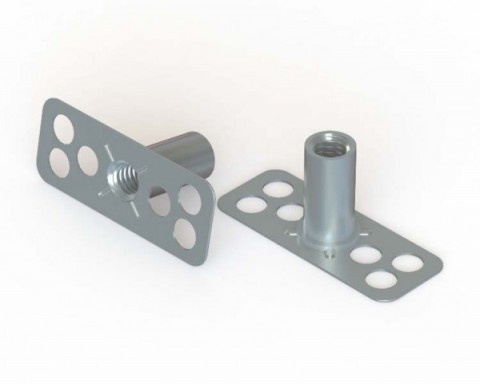
The high-performance bonding stud “Male stud bonding fastener heavy duty” from Specialinsert®, Master-Plate® PRSY, is the ideal solution for blind, heavy-duty fastening of threaded studs (M5–M10) onto any adhesive-compatible material — without drilling or mechanical stress. Whether you use zinc-plated steel or stainless steel 316, this fastener ensures a strong, reliable bond when fixed with the correct two-component adhesive. The non-perforated base plate in zinc-plated steel or stainless steel 316 ensures consistent adhesive thickness thanks to 0.5 mm spacers underneath, reducing adhesive consumption by 72% and improving bond reliability.
Description
Available Versions
• Threaded studs: M5 up to M10
• Stud length options: 45, 50, 60, 70, 80, 90, 100 mm
• Base plate: non-perforated (PRS/PRSY version) — provides large contact surface for adhesive bonding
• Materials: zinc-plated steel or stainless steel 316 (AISI 316)
Thanks to the chamfered head and welded connection, the PRSY heavy-duty version offers enhanced torque resistance and better pull-out and shear strength. The spacer-feet under the non-perforated base ensure the correct adhesive thickness (approx. 0.5 mm gap), optimizing bond consistency and reducing adhesive consumption.
Why Choose Bonding Instead of Drilling?
• No drilling — ideal for composites, plastics, metals, natural stone, glass or sandwich materials where maintaining integrity is crucial.
• Avoids weakening of substrate and eliminates risk of leaks or cold-bridges.
• No galvanic corrosion risk when using stainless steel 316.
• No mechanical stress on substrate — good for thin or sensitive materials.
• Clean look and greater design freedom for engineers and designers.
Installation & Adhesive Recommendations
Apply a suitable structural adhesive (e.g. epoxy or acrylic-based, depending on substrate and environmental conditions). Prepare the mounting surface carefully — clean and, if needed, abrade or prime. Press the stud onto the adhesive so the base plate rests evenly; when cured, the bonded stud delivers strong tensile and shear resistance.
For critical load-bearing or vibration-prone applications, we recommend performing preliminary bond tests. We can support you with factory sample production and testing.
Typical Applications & Advantages
-
Fastening in composites, plastics, metals, natural stone, glass or sandwich panels
-
Use in industries such as furniture, construction, transport, marine, aerospace — wherever drilling is undesired or impossible
-
Secure mounting of bolts for heavy loads without compromising material integrity
-
Reduction of weight, leaks, corrosion and surface damage compared to traditional mechanical fasteners
Download PDF
master_plate_high_performance_stud_prs_prsy.pdfFrequently asked questions about Male stud bonding fastener heavy duty
How strong is the bond?
Strength depends on the adhesive, the substrate, surface preparation, and bonding area. Correct surface prep is essential and testing is advized. The factory can test if samples are provided in Italy.
Can they handle vibrations?
With the right adhesive applied in the rigth circumstances, bonded fasteners can perform well under vibration loads.
What materials can they be bonded to?
They are typically used on composites, plastics, metal panels, honeycomb structures, carbon fiber, and thin sheet materials.
Which adhesives are recommended?
Usually structural adhesives like epoxy, methacrylate or polyurethane. Give us more info about the application and in cooperation with a adhesive manufacturer, we can provide specific adhesive guidelines.
Are the bonding fasteners always on stock?
For the best-selling items, of course, yes. For the other dimensions, the individual stainless steel components are very often in stock at the factory and only still need to be welded, so you should count on a minimum quantity of 200 pieces and a delivery time of 3 to 4 weeks. For the zinc-plated steel versions, the minimum quantity is 500 pieces due to the galvanizing process, which results in a longer delivery time of 5 to 6 weeks.
When is the non-perforated base plate type interesting?
In general, it can be stated that for medium-sized and large series, the non-perforated bonding fasteners are often more interesting, as on the one hand you save on average 72% of adhesive and on the other hand the quality of the bonded joint is improved.
The bonding quality is then much less dependent on the individual operator.
The shear strength is also higher than with the perforated version.
We recommend checking stock availability, as these items are often not on stock.