Nut bonding fastener


Nut bonding fastener on any surface?
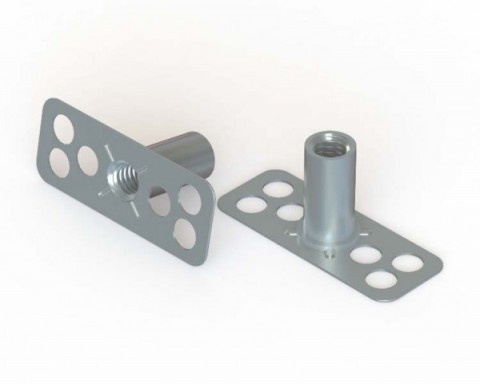
The Master-Plate® nut bonding fastener by Juno Industries that has a through-hole plate, type DRP, is a metal nut that can be glued on all kinds of material from composites, metal, wood, thermoplastic plastics, natural stone up to glass.
Also available with blind hole plate as type DRC so that no adhesive can enter the innerthread.
Description
What is a nut bonding fastener?
The nut bonding fastener, through hole plate type DRP is an open metal nut that can be glued on all kinds of material from composites, metal, wood, thermoplastic plasticsnatural stone up to glass. The advantage of the open plate is that it can receive a long bolt that can be screwed all the way through the base plate.
The closed type nut bonding fastener, type DRC has a blind base plate wich has the advantage that no glue can introduce itself in the innerthread of the nut while pushing the base plate in the adhesive.
The standard nut bonding fastener start from M4 to M10, in steel zinc plating or stainless steel 316L. Thanks to the perforated base plate, the nut bonding fastener will be firmly anchored to the receiving material as the adhesive flows thrue the perforations.
Heavy load application?
Recently, a stronger version of the nut bonding fastener has been introduced that uses a chamfered headed nut that is welded on to the base plate, the model DFP (trough-hole base plate) and a model DFC (blind base plate). These are available from M4 up to M6.
Want to save adhesive on bonding fasteners?
In case you want to save on adhesive cost, check out the recently launched DRCY, DRPY, DFCY and DFPY versions since they have a non perforated base plate that is equipped with 4 round spacers that garantuee the right distance (0,5mm) and therefor the right amount of adhesive.
Nut bonding fastener in stainless steel 316 and in steel zinc plating!
Both versions exist in stainless steel 316 that performs better in chemical agressive surroundings and also in steel zinc plating.
Always check the right adhesive to use in function of the materials, temperatures, humidity and chemicals that can come in contact during the life of your application.
How to attach without drilling?
An bonding fastener is designed to be attached to composite, metal, and plastic surfaces without the need for drilling holes. The standard range includes male stud bonding fasteners, nut bonding fastener, and bonding spacers of various types and sizes, as well as cable ties. This allows easy fastening of cables and hoses. Drilling is unnecessary because this method utilizes a base plate and adhesive. This reduces the potential for leaks as well as cold bridges. Additionally, there is no risk of galvanic corrosion, as they are available in stainless steel (ss316). The use of adhesive does not create tension in the material. Since they can be attached to any adhesive material, this offers design freedom.
Other combinations remain possible as Specialinsert welds all pieces in their own factory!
Download PDF
master_plate_perforated_drp_dfp_drc_dfc.pdfFrequently asked questions about Nut bonding fastener
How strong is the bond?
Strength depends on the adhesive, the substrate, surface preparation, and bonding area. Correct surface prep is essential and testing is advized. The factory can test if samples are provided in Italy.
Can they handle vibrations?
With the right adhesive applied in the rigth circumstances, bonded fasteners can perform well under vibration loads.
What materials can they be bonded to?
They are typically used on composites, plastics, metal panels, honeycomb structures, carbon fiber, and thin sheet materials.
Which adhesives are recommended?
Usually structural adhesives like epoxy, methacrylate or polyurethane. Give us more info about the application and in cooperation with a adhesive manufacturer, we can provide specific adhesive guidelines.
Are the bonding fasteners always on stock?
For the best-selling items, of course, yes. For the other dimensions, the individual stainless steel components are very often in stock at the factory and only still need to be welded, so you should count on a minimum quantity of 200 pieces and a delivery time of 3 to 4 weeks. For the zinc-plated steel versions, the minimum quantity is 500 pieces due to the galvanizing process, which results in a longer delivery time of 5 to 6 weeks.
When is the non-perforated base plate type interesting?
In general, it can be stated that for medium-sized and large series, the non-perforated bonding fasteners are often more interesting, as on the one hand you save on average 72% of adhesive and on the other hand the quality of the bonded joint is improved.
The bonding quality is then much less dependent on the individual operator.
The shear strength is also higher than with the perforated version.
We recommend checking stock availability, as these items are often not on stock.